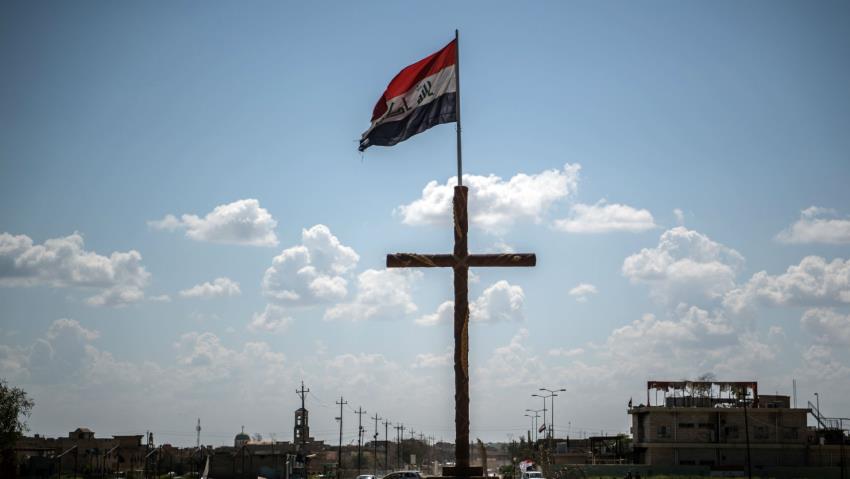



Father Nadhir Dako’s voice is barely audible as the call to prayer sounds from nearby mosques in the neighbourhood of Dora in southern Baghdad.
“There was an altar, there, in the middle,” he says softly, walking through the deserted church. “And a cross…I used to celebrate mass as a parish priest of this church in 1996. And look now, there is nothing left. There are not even Christian families living in this neighbourhood anymore”. Saint Jacob church was burnt down by Islamic State (IS) militants in 2015 and never rebuilt. “It does not even make sense anymore,” sighs the 55-year-old priest. Before the US invasion in 2003, Dora hosted the largest community of Assyrian Christians in the Iraqi capital. Today, the nearest church is a few blocks away but grows emptier every week. Before the fall of Saddam Hussein, Iraq was home to one of the largest Christians communities in the Middle East but years of war, persecution from Al Qaeda, and then IS, has forced thousands of Christian families into exile.
“There are less than half a million Christians left in all Iraq, out of six million in 2003. In Baghdad they were more than 750,000. Today, they are no more than 75,000,” explains William Warda, President of the Hammurabi organisation for the protection of religious minorities. During 35 years as a priest in Baghdad, Father Nadhir Dako has seen many churches close down. In his parish, the Chaldean church of Saint Joseph in Karrada, central Baghdad, the situation is also bleak. “I have around 150 families of the faithful left. All the others went to Turkey, Jordan or Europe and no one ever managed to come back. In their absence, Shia pro-Iranian militias who dominate Iraqi society seized their properties”. In a country controlled by corruption, jobs in public administration positions are often distributed among influential members, nearly all Sunni or Shia. As each day passes, more and more Christians consider the possibility of leaving Iraq, which is facing the worst economic crisis in recent times. “Here in Karrada, a lot of people work in shops in the zone where anti-government protests raged from October 2019. And then, months of lockdown because of the Covid-19 pandemic made the rest,” explains the priest. But communitarian disputes are also a pressing concern. Sanaa Hannah Aissa and her husband Raad Aso Sabri lost two children because of IS. Years after the end of the so-called caliphate, they still don’t feel safe to express their faith in Baghdad. “When we sit on our porch, we cannot help thinking that our children got killed here and anybody could come back to hurt us again,” they say mournfully, holding in their hands photos of their murdered boys. Years of war have also impacted the community spirit and mutual assistance once present in the parish.
“Our hearts are always in pain. We all have our problems and none of us has any strength left to take care of others,” admits Sanaa.
About The Author

Harrison Okafor
editor
Judith is a believer, a lover of Christ and a Gospel freak person. A passionate gospel blogger and press writer. I work with GospelHitsNaija.net Media, no 1 Gospel music platform.