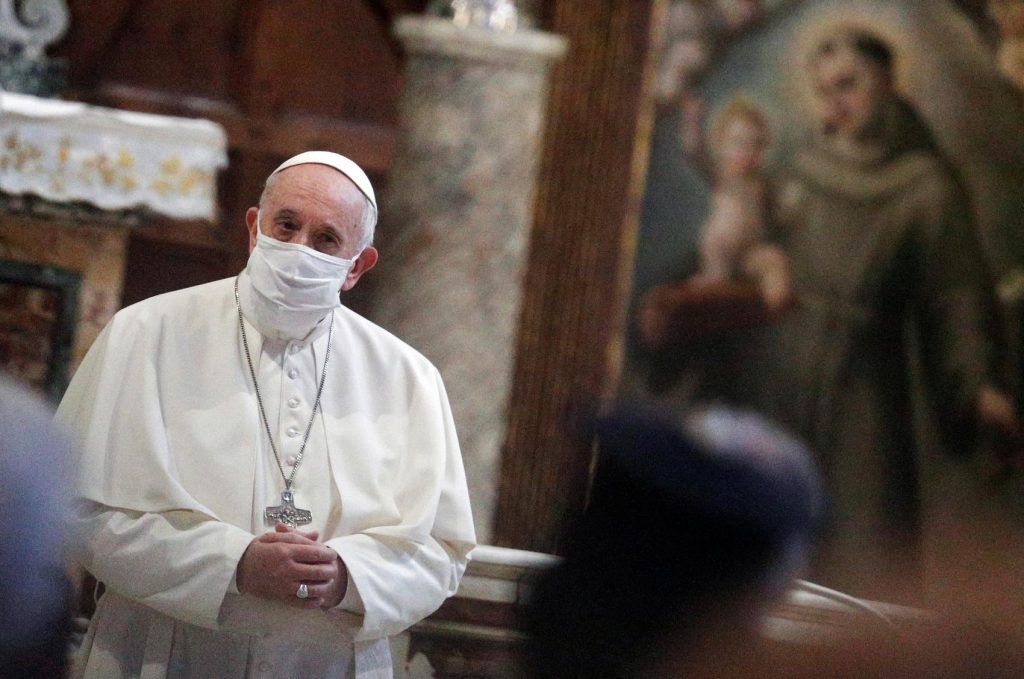



Once again Pope Francis is spreading confusion among the faithful. How many times must this happen before all good Catholics recognize that we have a serious problem in the Church, and its name is Francis?
“What we have to create is a civil-union law,” the Pope told an interviewer in a newly released video. The topic was same-sex marriage, and the Pontiff dutifully affirmed the Church’s clear teaching that marriage must involve a man and a woman. But then he undermined that teaching, encouraging people in the mistaken belief that the Church will eventually take another step to accommodate same-sex marriage. “Homosexuals have a right to be a part of the family,” the Pope said, explaining his novel stand. Yes, but they do not have the right to redefine the family—which has always been the goal of the gay-rights movement. In the interview the Pope essentially confirmed reports that in 2010, while serving as Archbishop of Bueno Aires, then-Cardinal Bergoglio had recommended civil unions as an alternative to legal recognition of same-sex marriage in Argentina. At the time the Vatican had taken a clear position in opposition to such proposals. The Congregation for the Doctrine of the Faith (CDF) explained in 2003—in a statement crafted by the future Pope Benedict XVI and approved by Pope John Paul II: Legal recognition of homosexual unions or placing them on the same level as marriage would mean not only the approval of deviant behavior, with the consequence of making it a model in present-day society, but would also obscure basic values which belong to the common inheritance of humanity. The Church cannot fail to defend these values, for the good of men and women and for the good of society itself.
What did the civil-union proposals of that era seek to achieve? Homosexuals could already designate their partners as their heirs and their medical surrogates; they could co-sign legal documents. The only legal privileges denied to them were those that have been traditionally accorded only to married couples. So the CDF recognized the civil-union proposals as a threat to the unique legal status of marriage. In opposing that threat the CDF was not taking a stand on a particular political proposal, so much as it was upholding the unchanged and unchangeable teaching of the Church—and of all Judeo-Christian tradition—that the family based on marriage is the fundamental building-block of society and deserves the government’s support and protection. Granted, the CDF statement was not issued ex cathedra. So conservative defenders of Pope Francis will no doubt continue their valiant efforts to explain how his statements can (after some strenuous mental gymnastics) be reconciled with Catholic doctrine. But is there any doubt that the Pontiff’s statement makes it more difficult to defend the traditional teaching? When Father James Martin says that this is “a major step forward in the Church’s support for LGBTQ people,” he implies that it is a step toward a certain goal. Millions of people, reading the headlines generated by this statement, will conclude that Church teaching is changing, and will continue to change until that goal is reached. By the way, why did the Pope say that “we have to create” civil unions, when civil unions are already recognized in Italy, and most of the neighboring European countries have taken the next step and legalized same-sex marriage? Ten years ago, when he proposed civil unions as a compromise, we might have questioned his political acumen. Today the impact of the papal statement is considerably more damaging. He is, in effect, relinquishing any claim to territory that the opposing forces have already occupied—and thus creating new obstacles for any Catholics who seek to regain that territory in the future.
Surely Pope Francis knew, when he made this statement, what sort of reaction it would cause. Why did he make the statement, then? Again and again he has made statements which, if they do not flatly contradict the Bible and Christian teachings we know.
About The Author

Harrison Okafor
editor
Judith is a believer, a lover of Christ and a Gospel freak person. A passionate gospel blogger and press writer. I work with GospelHitsNaija.net Media, no 1 Gospel music platform.