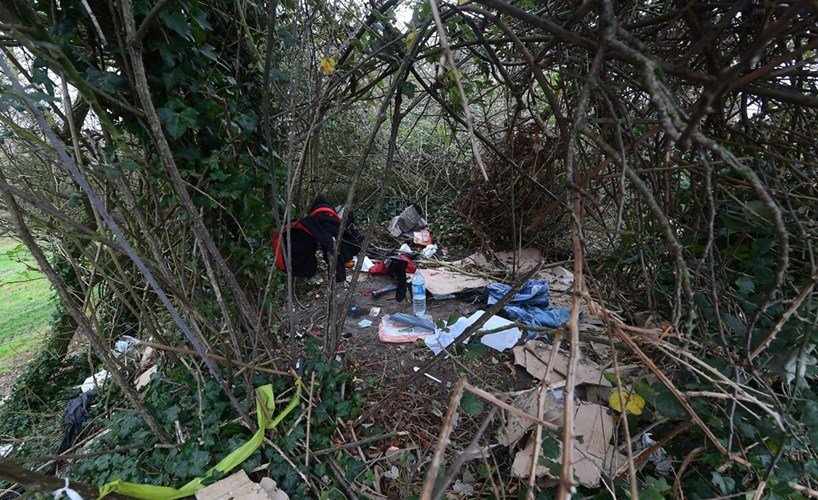



A forest dwelling abandoned by refugees in Calais, last week, before the French authorities carry out deforestation to prevent resettlement of migrant…
THE Bishop in Europe, Dr Robert Innes, has joined humanitarian charities in calling for the humane treatment of refugees whose suffering in already poor living conditions in camps on the Continent is being compounded by Covid-19 and the harsh winter months. He said on Tuesday: “As we near the end of 2020, thousands of vulnerable refugees have sought to cross the English Channel from Calais, while thousands more remain trapped in inhumane conditions in northern France. Covid-19 health risks have worsened the situation. “As Christians, we believe in human dignity rooted in the creation of each person in God’s image, and that everyone possesses innate human rights. Jesus identifies with the refugee and the oppressed and calls on us to similarly identify compassionately with the vulnerable.” The organisation Help Refugees reports that, in 2020, there are still more than 1500 people living in the forests in northern France, almost 200 of whom are unaccompanied children. In Calais, about 1000 people are sleeping in forests, under bridges, and behind industrial buildings, often with only a sleeping bag for protection. Dr Innes’s statement reflects one co-signed by the Anglican Communion with European and global Churches and faith partners in September. It makes a commitment to advocating the establishment of safe routes for legal migration; stepping up shared responsibility across Europe to implement the EU Pact on Migration and Asylum; and to combating “the fear of displaced peoples among us” by means of “better integration in local communities”.
Dr Innes asks that “the UK and French governments focus on managing the refugee situation in Calais humanely and equitably, respecting the rights of asylum-seekers under the European Convention on Human Rights. “In the Brexit context, I am particularly concerned about the potential lapse of the Dublin III provisions on 31 December 2020, which currently determine where and how an asylum claim in the EU is processed. I am especially concerned to secure child-refugee rights to reunion with family members, which Church of England bishops supported in the House of Lords in October. I await eagerly the position of the UK Government on this. “We must give Advent hope to refugees in Calais, and right across Europe. . . Calais reminds us of our need to address a refugee situation in our time, and that our responses to it should lie at the heart of our humanity.” Aid agencies are also calling on governments to recognise the rights of refugees to food, shelter, and dignity by providing assistance and opening safe routes for travel from the war-torn countries that people are fleeing. The head of the humanitarian division at Christian Aid, Michael Mosselmans, said: “Refugees in Calais and elsewhere are human beings who have endured perilous journeys to escape hostile, life-threatening, and dangerous conditions in their countries of birth. We should treat them as we would hope to be treated ourselves if we had to flee violence, persecution, oppression, and conflict in our country. “They have a right to protection, assistance, food, shelter, and dignity. Covid-19 has made their very difficult conditions even more precarious and troubling. All Governments should respond to their needs and rights with empathy, generosity, and respect. We will not succeed in overcoming Covid-19 unless we make serious efforts to protect all human beings from its effects, especially the most vulnerable members of our society.”
About The Author