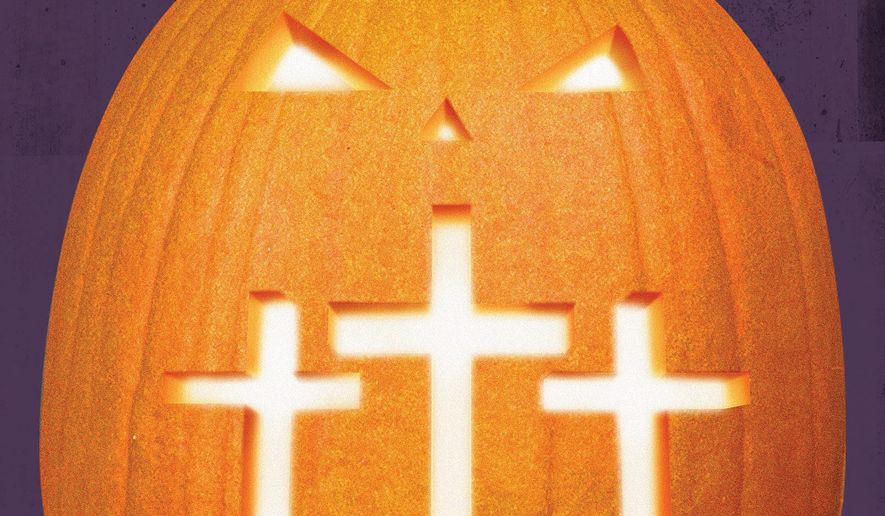



Every October, Christians trash each other on social media over Halloween. Is it harmless costumes and candy? Participation in the occult, cavorting with demons? Co-opting a pagan holiday?
Christians believe demons are real. The Bible talks about them. Most Christians agree that you should stay away from them. Fallen angels lurking in your kid’s candy bag might freak out a Christian mom or dad. And the stranger-sabotaged candy scares of the 1980s still haunt some parents. Halloween remains popular among American Christians. Yet this stalking sense of the demonic has some churches holding sanitized “harvest festival” events, away from the gruesome imagery in the streets, satisfying the family desire to participate without the risk. Other Christians take the hardline tactic of pointing out historical links to the Celtic pagan Samhain festival, supposedly the “real” Halloween. Trick-or-treating is declared equivalent with Ouija boards and seances. The 5-year-old in her princess tutu and tiara overloading on sweets is basically equivalent to a necromancer. What is rarely discussed in these unhallowed debates is what exactly Halloween is. The term gets used for everything from neopagan reconstructions to Catholic cemetery processions for All Hallows’ Eve, to costumed parades through the Main Streets of small-town America.
One friendly neopagan informed me that her religion’s holiday is not about demons. I responded that even Christian holidays such as Christmas and Easter are actually about demons. For in the tradition of the Eastern Orthodox Church, the unseen world of angels, demons, spiritual powers, giants and other mythic-level themes in Scripture is taken seriously. That means that Halloween is also about demons. But that isn’t a problem. Most popular Christian preaching and teaching focuses on man’s problem with God or God’s problem with man (depending on your theology). But rarely does it discuss man’s problem with demons or the demons’ problem with God. Yet these themes are in the Bible. Consider the incident in Mark 5 (and Luke 8 and Matthew 8) where Jesus drives demons out of the man called Legion and into a herd of pigs. Or the confrontations in Job 1 and 2 between God and the Satan in the presence of the “Sons of God” (angels obedient to God). You don’t have to look very hard in the Bible to see that there is a demon problem. God has enemies, and they’re the fallen angels.
The Bible calls the gods of the nations “demons” (Ps. 96:5, Deut. 32:17, 1 Cor. 10:20), identifying the beings pagans worshiped as fallen angels. It never says they don’t exist. Confrontation between demons and God and his angels is a perennial subject in the Bible. And for the Eastern Orthodox Church, Christianity is about joining that confrontation on the side of God and his angels. For instance, the Orthodox sing at Christmas that “they who worshiped the stars were taught by a star to adore thee, the very Sun of Righteousness.” The stars and other celestial bodies are traditionally associated with spiritual beings, and some were worshiped by pagans such as the Magi from the East. Christ’s birth is a blow to the worship of stars, with another star (led by an angel) redirecting worship away from demons to Jesus instead. At Easter, the Orthodox sing “Let God arise and let his enemies be scattered” (Ps. 68:1), an invocation meaning that when Jesus rises from the dead, the demons tuck tail and run. Jesus engaged in exorcism throughout his ministry, so his final victory over death — long associated with the devil who holds the power of death (Heb. 2:14) — will of course send them running.
In the Christian context, Halloween is the evening before the feast of All Saints. In Western world, Halloween is a celebrated of the haunted.
About The Author

Harrison Okafor
editor
Judith is a believer, a lover of Christ and a Gospel freak person. A passionate gospel blogger and press writer. I work with GospelHitsNaija.net Media, no 1 Gospel music platform.